


Author and Page information
- This page: https://www.globalissues.org/article/803/cop19-warsaw-climate-conference.
- To print all information (e.g. expanded side notes, shows alternative links), use the print version:
On this page:
Introduction
November 11 – 23, 2013, Warsaw, Poland was the venue for the 19th annual United Nations Climate Change Conference, also known as the 19th Conference of the Parties — or COP 19.
The purpose of this conference was to create a loss and damage pillar of a new climate treaty to be finalized in 2015. The other two pillars discussed in previous meetings are mitigation (emission reductions) and adaptation pillars.
Meeting outcome
The main outcome of the meeting was the establishment of an international mechanism for a loss and damage associated with climate change impacts .
Predictably, the loss and damage aspect of climate negotiations brought out the worst in some countries. Some developing countries were going to resist the idea of financing adaptation to climate change, while others appeared to hate the idea of climate reparations for poor countries. A few years earlier, industrialized nations had made a legal commitment to a global climate fund. Unsurprisingly, not much came of it, as Inter Press Service summarized,
In 2009 at the semi-infamous Copenhagen talks, the rich countries made a deal with developing countries, saying in effect:
We’ll give you billions of dollars for adaptation, ramping up to 100 billion dollars a year by 2020, in exchange for our mitigation amounting to small CO2 cuts instead of making the big cuts that we should do.The money to help poor countries adapt flowed for the first three years but has largely dried up. Warsaw was supposed to be the
Finance COPto bring the promised money. That didn’t happen.Countries like Germany, Switzerland and others in Europe only managed to scrape together promises of 110 million dollars into the Green Climate Fund. Developing countries wanted a guarantee of 70 billion a year by 2016 but were blocked by the U.S., Canada, Australia, Japan and others.
It got to the point that hundreds of representatives from various NGOs walked out of the negotiating rooms to protest against developed countries’ reluctance to commit to a loss and damage mechanism. And this was a day after the G77+China group of 133 developing countries walked out of negotiations over the same thing.
Looking through the briefing reports from the respected NGO, the Third World Network, It seems that on the surface, while an outcome was eventually thrashed out, there are many areas of weakness of sufficient vagueness to satisfy everyone that contentious issues that are seemingly resolved can still be challenged and changed in the future.
In context: common but differentiated responsibilities
Many years ago all nations agreed that climate change was largely the result of actions from today’s industrialized nations, as carbon dioxide — the main greenhouse gas — stays in the atmosphere for decades. Yet, the poorest would end up suffering the most for a problem they largely did not cause. The approaches to mitigation (emissions reduction) would therefore be different for those groups of countries — the common but differentiated responsibilities principle.
It is in this context that the discussion for loss and damage has come about. And it is something that rich countries are keen to get rid of .
The years of resistance on this issue (and many others) means each time it is discussed again the reactions seem to get even more hostile. Combined with the lack of detailed context in the mainstream media coverage of this aspect, it then becomes easier each time to see culprits as China and India given their enormous greenhouse emissions in recent years, compared to the far greater amount by the industrialized nations over the longer period. See this site’s section on climate justice for more detailed background.
In context: Typhoon Haiyan
The meeting came at the time when the devastating Typhoon Haiyan had just killed thousands in the Philippines and affected millions more. It was an ominous warning of what could be more frequent as climate change continues to take hold.
It was also an example of how poorer nations could be affected by a problem they have largely not been responsible for and that while all the international outpouring of aid and assistance was incredibly welcome, that support for preventing and adapting to such events is paramount and efforts are urgently needed to curb emission increases.
In an emotional speech the Philippines lead negotiator for the conference, Naderev Saño, received a standing ovation for announcing that he will go on a hunger strike until a meaningful outcome is in sight.
Lack of urgency
Inter Press Service (IPS) noted the seeming lack of urgency given the years and years of delay and watering down of meaningful action:
To have a good chance at staying under two degrees C, industrialised countries need to crash their CO2 emissions 10 percent per year starting in 2014, said Kevin Anderson of the Tyndall Centre for Climate Change Research at the University of Manchester.
We can still do two C but not the way we’re going,Anderson said on the sidelines of COP 19 in Warsaw. He wondered why negotiators on the inside are not reacting to the reality that it is too late for incremental changes.
I’m really stunned there is no sense of urgency here,he told IPS.
More information
As the conference is still underway as this page is written, more information will be added here after the event is over.
For more about the issues from other organizations, here are some starting points:
News stories from IPS
Below is a list of stories from Inter Press Service related to the Warsaw climate conference and its aftermath.
-
Colombia’s next President: A Reckoning for Peace, Climate and Human Rights
– Inter Press Service

MONTEVIDEO, Uruguay, June 26 (IPS) – On 21 June Colombians made their choice. By the narrowest of margins, Abelardo de la Espriella, a far-right criminal lawyer who’s never held elected office, became president-elect. Climate activists, human rights defenders, Indigenous communities and peace advocates have the most to lose from the incoming government’s agenda.
-
Climate crisis: UN chief lays out solutions blueprint for clean energy transition
– UN News

As a deadly heatwave continued to grip Europe on Tuesday, UN Secretary-General António Guterres issued an impassioned appeal for more ambitious global action on climate change caused by fossil fuels, to prevent irreversible damage.
-
Climate shocks accelerating as El Niño threat looms over already vulnerable regions
– UN News
Millions of people already facing hunger, displacement and economic hardship could soon face another major climate shock, as UN agencies warned on Thursday that extreme weather risks are intensifying across some of the world’s most vulnerable regions.
-
UNICEF: Overlapping Climate Hazards Threaten Children’s Quality of Life
– Inter Press Service
UNITED NATIONS, June 16 (IPS) – A new report from the United Nations Children’s Fund (UNICEF) highlights the vast, overlapping climate threats affecting children worldwide, which is leaving them increasingly vulnerable to escalating risks across health, security, and education.
-
Triple climate threats affect nearly half the world’s children
– UN News
Drought, extreme heat and heatwaves are the most prevalent trio of hazards endangering millions of children globally, warned a newly released climate report by the UN Children’s Fund (UNICEF).
-
Health Emerges as a Strategic Frontline for Africa Ahead of Bonn Climate Conference
– Inter Press Service

Africa contributes the least to global greenhouse gas emissions, yet it faces some of the world’s most severe climate-related health impacts. Several realities define the continent’s climate and health landscape – increased infectious diseases, air pollution, death, disruption and pressure on health systems through heatwaves, floods, droughts and storms.
-
Violence, Climate Shocks, and Hunger Push The Sahel To The Brink of Collapse
– Inter Press Service
UNITED NATIONS, June 10 (IPS) – Over the past few years, the humanitarian crisis in Africa’s Sahel region has expanded considerably, largely driven by a surge of violence—particularly in the Central Sahel. Although the crisis has been described by the United Nations (UN) as having “largely faded from the headlines” since its wake in 2012, millions of people across the region are in dire need of humanitarian assistance as civilian displacement, climate shocks, and widespread hunger rapidly spill across borders.
-
Countries urged to ‘go further, faster’ and deliver on climate commitments
– UN News

The United Nations climate chief called on Monday for countries to step up action to implement existing commitments, warning that fossil fuel dependency is deepening economic instability and exposing vulnerable communities to worsening climate impacts.
-
UN Climate Resolution: Time to Protect Activists
– Inter Press Service
LONDON, June 5 (IPS) – Ahead of World Environment Day, the UN General Assembly made a vital commitment to protect people from climate impacts, adopting a resolution on the climate change obligations of states. The resolution follows up on the International Court of Justice (ICJ) advisory opinion issued last year, which found that states have a legal duty to prevent activities that cause environmental harm. Most states voted for the resolution despite a concerted campaign by the Trump administration to block it.
-
Governments Falling 90 percent Short of Climate Adaptation Finance Needs
– Inter Press Service
BRUSSELS, Belgium, June 3 (IPS) – Governments are falling 90 percent short of adaptation finance targets and leaving people in climate-vulnerable communities drastically under-equipped to cope with the devastating impacts of climate change, Oxfam warns ahead of Bonn climate talks (8-18 June).
-
“The Heat Is No Longer Distant: A Global Climate Reckoning“
– Inter Press Service

VICTORIA, Seychelles, May 29 (IPS) – ‘As record heat sweeps the world, the climate crisis is no longer a warning for the future, but a reality of the present.’
-
UN General Assembly Votes for Resolution on ICJ Advisory Ruling on Climate Obligations
– Inter Press Service
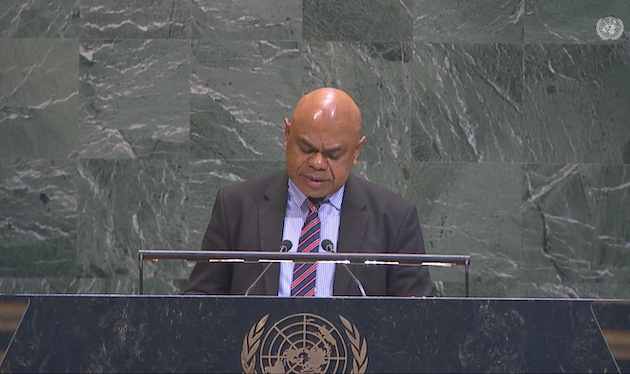
UNITED NATIONS, May 21 (IPS) – Member states this week (May 20) deliberated over a draft resolution on states’ obligations in respect of climate change following the advisory opinion from the International Court of Justice (ICJ). The General Assembly agreed to take measures to uphold the ICJ’s advisory opinion for member states to meet their existing obligations to climate justice under international law and multilateral frameworks.
-
India: Climate Diplomacy Questioned After COP33 Hosting Withdrawal
– Inter Press Service

India has withdrawn its bid to host the 2028 United Nations climate summit, a move that indicates a recalibration of its global climate engagement even as it projects itself as a leader in renewable energy and climate action.
-
General Assembly backs historic World Court climate crisis ruling
– UN News

A landmark General Assembly resolution adopted on Wednesday is “a powerful affirmation” of international law, climate justice and science, according to UN chief António Guterres.
-
World Urban Forum opens in Baku as housing crisis and climate shocks intensify
– UN News

Soaring housing costs, climate shocks and conflicts are leaving millions without adequate shelter – but what can be done? As the 13th UN World Urban Forum opens on Sunday in Baku, Azerbaijan, participants will grapple with solutions to a deepening global housing crisis.
-
Oil, plastics and climate: Why higher prices could speed a materials transition
– UN News

As oil prices have risen amid geopolitical turmoil, one perhaps overlooked driver of climate change is coming into sharper focus: the production of plastics which are deeply tied to fossil fuels.
-
Africa’s Youth are Shaping the Continent’s Climate Future
– Inter Press Service

UNITED NATIONS, May 5 (IPS) – Africa is on the frontlines of the climate crisis, warming faster than the global average and facing disproportionate climate impacts, despite contributing the least to global greenhouse gas emissions.
-
Climate-Driven Disruptions to Education in Africa Raise Protection Risks for Millions of Children
– Inter Press Service

UNITED NATIONS, April 29 (IPS) – The escalating global climate crisis has led to an increase in the frequency of climate-induced natural disasters, affecting millions worldwide. As governments struggle to keep up due to persistent funding shortfalls and inadequate preparedness and response mechanisms, education systems in Eastern and Southern Africa continue to deteriorate, pushing millions of children into displacement and poverty, further deepening long-term inequalities.
-
Bridging Knowledge Systems: How Pacific Communities Are Reclaiming Climate Solutions Through Nature
– Inter Press Service

NAIDIRI, FIJI, April 17 (IPS) – Climate change is no longer a distant threat. Across the Pacific, it is a daily reality reshaping coastlines, livelihoods, and the delicate balance between people and the environment. But in a region long defined by resilience, solutions are not being invented from scratch. They are being remembered, strengthened, and scaled.
-
War-driven energy price spikes highlight value of renewables: UN climate chief
– UN News

The disruption of global energy supplies is being felt worldwide, the UN’s top climate change official warned on Monday, as conflict in the Middle East drives oil and gas prices sharply higher – echoing the market turmoil triggered by the war in Ukraine.
-
Climate Change Is Coming for Your Morning Coffee
– Inter Press Service

BULAWAYO, Zimbabwe, February 27 (IPS) – Your morning cup of coffee could soon cost more, thanks to climate change, which is raising the heat on the production of the world’s most loved beverage.
-
Local Resilience Can Mitigate Climate Conflicts in the Pacific
– Inter Press Service

The Pacific Island countries are at the frontline of climate change. Their territories mostly consist of small, low-lying islands, with long coastlines and vast ocean spaces between them. Many livelihoods are based on agriculture or fishing, and importing water or food is often infeasible or expensive. This makes those large ocean nations highly vulnerable to the impacts of climate change, such as storms, droughts, and rising sea levels. Analysts have expressed concerns that this can result in various forms of socio-political conflict.
-
U.S. Exit from Paris Agreement Deepens Climate Vulnerability for the Rest of the World
– Inter Press Service

UNITED NATIONS, January 30 (IPS) – On January 27, the United States officially withdrew from the Paris Agreement, an international treaty adopted in 2015 aiming to reduce global warming and strengthen countries’ resilience to climate impacts. Following a year of regulatory rollbacks and sustained efforts by the Trump administration to dismantle federal climate policy, this move is expected to trigger wide ranging ripple effects—undermining international efforts to curb climate change, accelerating environmental degradation and biodiversity loss, and increasing risks to human health, safety, and long-term development.
-
From family farm to climate tech: How one Kenyan woman is helping farmers outsmart drought
– UN News

“Giving up is not an option – so many people depend on you,” the words of Maryanne Gichanga, a participant in a UN supported initiative, which aims to help farmers in Kenya find solutions to alleviate the pressures of climate change on agriculture production.
-
What Next? United States Exits Key Entities, Vital Climate Treaties in Major Retreat from Global Cooperation
– Inter Press Service

NAIROBI, January 15 (IPS) – President Donald Trump has escalated efforts to further distance the United States from international organizations and entities focused on climate, the environment, and energy. This strategy is in step with his administration’s established approach to undermine and redirect funds and international cooperation away from climate and clean energy programs.
-
Excluding Food Systems From Climate Deal Is a Recipe for Disaster
– Inter Press Service

BULAWAYO, January 9 (IPS) – As they ate catered meals, COP30 negotiators had no appetite for fixing broken food systems, a major source of climate pollution, experts warn.
-
What the US withdrawal from UN bodies could mean for climate, trade and development
– UN News
The United States’ intention to withdraw from a host of UN bodies announced this week targets programmes and initiatives focusing on a wide range of crucial areas, including the climate crisis, trade, gender and development.
-
How climate change is threatening human rights
– UN News
With rising effects of climate change across the globe, the world has started recognising that climate change is not just an ecological collapse, but also a human rights crisis.
-
Climate Justice Denied by Delays
– Inter Press Service

KUALA LUMPUR, Malaysia, December 23 (IPS) – Opinions have been divided over the annual UN climate conferences. While some see COP30 in Belém, Brazil, as confirming their irrelevance, others see it as a turning point in the struggle for climate justice.
-
‘We Need a New Global Legal Framework That Rethinks Sovereignty in the Context of Climate Displacement’
– Inter Press Service

CIVICUS discusses climate displacement and Tuvalu’s future with Kiali Molu, a former civil servant at Tuvalu’s Ministry of Foreign Affairs and currently a PhD candidate at the University of the South Pacific in Fiji and the University of Bergen in Norway. His research focuses on state sovereignty and climate change in the Pacific.
Author and Page Information
- Created:

